“This is your seventh baby? This one is going to just pop right out, you will see…”
I can’t tell you how many times I heard that over the past few months.
My youngest is 5 1/2 – which means it has been a while since I have been pregnant. I was younger, fitter, and while I had my hands much more full with a house full of little ones, I also had more energy.
This pregnancy was harder. Much harder…… but it was nothing compared to the labor/delivery.
None of my other deliveries were easy, but they were pretty straightforward. I have shared with just about any woman who will listen that I proudly delivered twins without an epidural or surgery at 40 weeks – and 6.5 and 8 pounds.
This labor was more than a day, on no sleep, with a “failure to progress”. I was spared a c-section, but at the price of tremendous amounts of strain on my body, the likes of which I have just never experienced.
… I don’t know if it is my age, the hormones, the difficult labor, the very full house or a grand combination of them all, but this time post-partum hit me BIG TIME.
I found myself just crying for what seemed like no good reason. I felt overwhelmed, and mostly I resented every single person that tried to check in with me, asked me what I was doing, expected me to be chipper, friendly, happy, open or affectionate. Including my own children.
“Can’t they see I am trying to recover?”
“What is wrong with them? Why are they calling me? ”
“How can they possibly ask me for a hug.”
“Just stopped by? Seriously?”
More than anything else, my moodiness, touchiness and lack of ability to be a charming friend and hostess to others seemed to be met with consternation at best, horror at worst, rather than compassion.
I am in week two now, and what an amazing difference a week makes! My milk is flowing, my child is occasionally sleeping for a whole couple of hours not in someone’s arms. I am no longer taking pain medication round the clock, feeling achy and weak the minute it starts to wear off. I can put on my own shoes. There is a rush of relief that the Shalom Zachor and the Brit are both over. The trauma of the birth doesn’t come to me in flashes like it did last week. Neither do the unexplained bouts of tears. I am able to smile when someone walks in the door, and you might, just might occasionally find me answering the telephone.
The help, advice and meals I have received have been just amazing.I think that religious Jews who have a community that takes turns at lifecycle events being there for each other, are the luckiest people on earth. And I count myself as one of the most blessed because I live in Neve Daniel. The love and support expressed from around the world has been so touching, so wonderful.
The most positive experience has been the communal celebration of this birth by our neighborhood, family and friends.
Why write such a negative post during this weekend of thanks??? Why bother writing this? Because I think that when we are truly happy for people we want to connect to them. To reach out and let them know. I also think that 9 times out of 10 a new mother, at least for that first week, needs exactly the opposite. Sometimes love means giving someone space.
I have always dropped off donated dinners to new moms with a note and a delivery person, and I have never thought to make a visit or a phone call in the first week. But I also doubt I have ever been sensitive enough to avoiding asking “how are you” for a week, or assuming that maybe a hug for the new mom is not in order at a bris. I never knew that difficult sleeping when your baby sleeps is a primary symptom of post-partum baby blues, but I have always known that lack of sleep makes everything else harder.
I have had many friends who suffered from post-partum depression, but I didn’t see it – that is part of what I am describing, which is a desire to shut everyone out during such a dark time. I heard about it after the fact. Until now, I never understood why it was traumatic enough to cause some of them to think twice before having another child.
I haven’t enjoyed the experience, but I do hope it is going to make me a better friend, relative, neighbor and eventually mother to new moms. That I will have a newfound appreciation for that space.
If you ever give birth and I seem aloof during your first week, please don’t be offended, I will just be giving you your space, whether you need it or not. My guess is that if you are a brand new mom, you will be FAR too busy to notice, no matter how you are feeling.

One last note: our beautiful new baby’s name is Yehuda Chaim, and I will post our thoughts and words on the baby and his name just as soon as this little newborn will grant me the time. In the meantime, wishing you all a wonderful Thanksgiving and Chanukah!!!
 I once had the honor of enjoying a shiur by Rabbi Shimon Green from Jerusalem who was visiting New Jersey. He said that everyone has “that person”; ” That person that drives you up a wall, that you simply cannot stand. That every little thing they do is so annoying it is like fingers on the blackboard – just for you…. but don’t worry he went on; you are undoubtedly that person to someone else!”
I burst out in the laughter of surprise and recognition. I am a second wife who has been dealing with a first wife, who hates my guts, for many years. Enough said, but far be it from me to assume I am only “that person” to her. I may be that person to a lot more people.
I also think, however, that the flip side is true. Many of us have “that person” that has made some huge, life-changing impact on our lives.
And quite often, I believe that “those people – ” the angels that appear as humans to us – don’t think of their own actions or behavior as anything much at all. Just as the people who seem to have no raison d’etre other than annoying us often aren’t even considering us for one instant, those that have a hugely positive impact on our lives aren’t trying to change us, or our lives, or even inspire us. They are just living.
My now 8-year old daughter had to go through the difficult process of aliyah only 15 months ago. She went from a small school, 5 minutes from home, where the staff were also members of her shul and community, were her Ima’s friends, gave her hugs, and were her extended family, to a huge public school with 30+ kids in a class, over 200 to a grade, and not a lot of personal interactions between individual students and staff…. all in a new language, of course.
Idit is one of the secretaries in the office, and I very much doubt that she realizes just how much she is “that person” for my daughter.
Shira began last year surprising Idit with hugs. While it certainly wasn’t the norm in her big Israeli public school, it was definitely my daughter’s norm from New Jersey. Idit responded with cookies. She didn’t realize that we don’t give our children cookies, except on Shabbat. It was most definitely the way to my daughter’s heart, as well as the beginning of a beautiful relationship.
The cookies have stopped, but the daily hellos – and hugs – have remained. Shira knows she has a friend, a go-to person, a safe harbor in the storm that is aliyah.
I had to drop off a forgotten assignment this week, and since I couldn’t find Shira, I gave it to Idit who assured me that she and Shira would find each other before the next class. She called me in before I could leave to tell me how much she loves my spunky daughter. She also wanted to add that Shira often comes to the office during recess, or stays inside, saying that she doesn’t know who to play with.
One of the hardest parts of aliyah is getting past kids being friendly to really making friends. (It’s true for the adults making aliyah too – a different blog post…) Idit suggested that I send Shira to school with a toy from home for the playground or something new that she can share with friends – or potential friends – that will both give her something to do and attract her peers. What a simple, easy idea. The next day Shira went to school with some sidewalk chalk in her bag and I am already hearing reports of improvement in her social life at school.
The teachers are busy, dealing with 30+ kids throughout the day, and they are not assigned to monitor the playground every day. When they do, they are literally watching hundreds of children. They are watching out for fights and violence (I am not confident they even catch most of that) but certainly are not on the lookout for the lone immigrant child that quietly opted to stay inside. Idit noticed. And her quiet, quick word to me was all that it took to bring a little more sunshine into my daughter’s life.
I will continue to try to convey to Idit how much more of an impact on my daughter she is having than she realizes, and I hope there is a point in her life where she comes to understand that by doing what must be a relatively thankless office job in a public school, she is meriting being an angel on earth for at least one little girl, and by extension her family.
… So what does that mean for me? It means yet one more reminder that I need to live my own life consciously, trying to be “that person” in the lives of others, rather than “that [other] person”….
Living in Israel and not owning a television means that on a good day I can shield my kids from most of what passes for “news” today.
**********
My kids didn’t want to go to school because for them every day at school is like going back into battle. Four months in a new country, they are dealing with bullies, lack of understanding the language and the material, being too far ahead in certain subjects and too far behind in others. All of the toilet paper in the bathrooms being used up by the end of 4th period. Teachers who care, they do, but have 25 other kids to worry about, instead of ten. Even the kids who are nice to them most often are still not “friends”. And the noise; Israeli buildings, including schools, echo more than American ones, and when the student population of their grade outnumbers the entire student body of their school (preschool-8th), it is just so noisy.
So they go off to battle every day, and some days are better than others, but it is still wearying, and still requires bravery. Now I understand why our young soldiers get such short periods of time to go home! Ten days of sleeping in, hugs and food from Ima, choosing the company you keep and quiet when you want it? Well, of course it is hard to give that up.
They didn’t want to be brave this morning. So they carried on, crying and yelling and threatening and being altogether unpleasant. After all, I moved them here, so ultimately it is my fault.
A part of me really wanted to give them some perspective. “Look at what just happened. Don’t you know what you have? What you are? Alive, that’s what! You are here, breathing and safe, and be grateful and go to school! But give me another hug first. “
I didn’t do that. The last thing in the world they needed was for me to add to their long list of fears. It wouldn’t have given them perspective, or taught gratitude. It would have reminded them that they are right that school requires bravery – of all unimaginable types, bravery that it just shouldn’t require.
But it gives me perspective. I can’t imagine how many parents didn’t want to send their kids to school today, or how many little children across America didn’t want to go to. Children who also cried and carried on… and unfortunately not simply because they have had a week and a half of sleep, warm food, vacation and quiet.
My condolences to the families and community of Newtown, CT. I hope that there is some source of comfort and healing there for all of you.
Have you ever had a day that was perfect? Truly perfect?
During sukkot (yes, that is right, it has taken me until Chanukah to write about it,) I and my family met one of my very best friends and her family at the beach in Ashdod. The weather was perfect, the waves were perfect, the scenery was perfect, and the company was even more perfect.
At some point in the afternoon the two husbands left with half of the kids, and I was left on the beach with my daughter joyfully riding waves and jumping into the arms of my friend. The kids that stayed with us were happy. No one needed me, no phone was ringing, no chores awaited; it was late in the day so not too hot or cold, and everything was, well, perfect.
As I sat there I tried to take in the moment and internalize it. To keep it recorded in my memory and in my soul so that I could go back there and visit it at some when life is feeling a lot less perfect. I also tried to figure out what Hashem wanted me to be learning from this slice of perfection. What am I supposed to learn from this beach, this day, in this scenario.

I spent a good part of the day in the waves myself. Waves that were big enough to lift you up and carry you, but not out of control or “hostile”. Most of the time I was riding with ease. At one point I was socializing, enjoying myself, but distracted, and I did get carried under. I was fine, but very concerned about my hair covering coming off, so I kept my head in the water until I could retrieve it and put it back on. I looked ridiculous, but there wasn’t anyone there to notice. (At least that is what I tell myself.)
It occurred to me, while sitting on the beach in complete solitude and bliss that was is true of the waves is true in the rest of the world that God has given us:
When we are prepared for what is coming, then we stand in the right place, catch the wave and use it as an opportunity to move, enjoying the process. When we aren’t prepared for what is coming, it comes anyway, and often knocks us down and pushes us under. We often feel like we are drowning, even when we aren’t, and have a hard time getting our footing again. Especially because once that wave catches us off guard, the next one just comes rolling in whether we have gotten back up or not.
There are experiences that come and are sometimes merely crises because we weren’t prepared for them. We can’t always know what will come our way, but I think that working on one’s faith is a lot like standing in position for the next wave. Having faith that is strong, developed and ready makes it so much easier for you to meet the next challenge and “ride” it through, and working on ourselves and our character, being in tune with the calendar and what God wants from us, instead of absently just going along, increases our chances of seeing the waves before they arrive – and crash down on our heads.
My friends are all excited – as it appears most of the computer users are – about Pinterest. I like it, but I am not in love. I remember seeing the growth and potential in twitter and wanting to share, but not having my contacts yet on there. I don’t feel that way about Pinterest, so I found it unsettling to read EVERYWHERE that Pinterest is a “girl thing”. Really? I am a girl? It seems to me that Pinterest is a visual thing.
And if it is a girl thing, well, so what? What does that mean? Along comes Clever Girls Collective, a network of women who blog and work in social media, with a great article on the topic. I really hope you will read it.
HOW TO STOP BEING A PINTEREST SEXIST
ESPECIALLY if you aren’t a girl.
I can’t continue to work in PR and social media without getting better acquainted, even if I don’t fall in love. Umm, it’s a work thing, you see…… If you are a pinterest user, I would love to hear why you love it and what you use it for.
I am on my way to a five day vacation with three women I know from elementary and middle school. We come from very diverse backgrounds and have chosen very different paths in life. Our lives and get together could probably qualify for some mid-life chick flick.
The vacation is a reunion for all of us. But what other functions this excursion has for each of us is as different as the rest of our lives.
I have a year of overwhelming commitments. I wanted to go back to work full time despite the challenge of juggling that with so many children to care for. I got what I wanted, but the price has been little time for reflection, contemplation – blogging – and going forward with my customary “strategy building” intentionality. I like to run my household by reflecting on how things are going, assessing what I would like to see continue / change, and modifying my own strategy and attitude. By committing my every waking minute, I have left myself no room for this part of my being – this crucial aspect of mothering. It is exhausting, and I can see that my family is paying the price.
I know this trip away from my family is as good for them as it is for me beyond the cliché platitude. Yes, of course a rested and relaxed Ima is a better one. But like any corporate retreat, the simple QUIET of my first hour on the airplane has given me more chance for reflection than the last six months of chaos.
I know it will be incredible to catch up with old friends, and hear how the story of their lives have been unfolding. But I also can’t wait to just catch up with myself.
 I don’t have a bucket list to complete “before I die.” I was born with this strange innate clock that is always running, reminding me that my time on earth is limited so I better use it while I’ve got it. It took me a long time to realize that not everyone feels that same internal ticking. One of the reasons I remain busy (only one of the reasons) is my desire to “get it all done” in this lifetime. It is very often an inadvisable approach.
But I do have big plans to move 6,000 miles away in only six months (!!!). and it has caused me to form a bucket list of sorts and to operate that way. I have gotten to enjoy a VIP experience at a rock concert for one.
Next week I have plans to go on vacation with three friends from Middle School. No kids, no husbands… hopefully no responsibilities. The fact that all four of us are turning 40 would have been enough reason, but I know that if I don’t do this now, it won’t happen. Ever.
I won’t get to everything I would like to cross of that list before we move, but I am seriously enjoying the effort along the way!
What’s on your bucket list?
It has been almost a full month since I last wrote a blog post. I am not sure if this is an indication that I have truly spent the month on vacation, or precisely the opposite.
Being at a house by the ocean that is not my own with a stream of visitors and visiting time withgrandparents has been wonderful. I am not sure I would use the word “leisurely” or “relaxing”. The lack of school structure for six kids for one month certainly might have eclipsed my ability to blog, beach house notwithstanding. I feel like I have been busy, and tired. I have spent a great deal of time shopping, cooking, cleaning and doing laundry.
I wrote last year about finding the moments of personal vacation within my family vacation, and every year this is a different experience, since the ages and circumstances of the family are always changing. I discovered kayaking this summer, because our old, dear and generous friends lent us theirs for two weeks. Out in the kayak in Barnstable Harbor, there was more than one moment this month when I could not hear a single sound. Not a child, not a phone; not even a boat or seagull. And I love the fact that my older brother showed me the ropes my first time out. No spa visits like last year. Not even some “escape shopping”.
I am experiencing a different kind of relaxation… and that is the sort of phase II with my family. What I mean is that we don’t have any babies, nor are we expecting one (right now). After years of vacationing with strollers and car seats, middle of the night nursing, bottles and diapers and bouncy seats and carriers, we are just a family with a gang of kids. Day trips are suddenly possible. The kids can buckle themselves in the car, or at least buckle each other. No sunscreen battles, or constantly running after a destructive 18 month old.
We are still in transition, don’t get me wrong; we are potty training, and still planning around the “baby’s” nap. But 3-11 years old(My SS sadly didn’t join us this year) feels REALLY different than a house full of babies and toddlers.
My pockets of personal vacation are less about escaping all of the child care because the child care is less intense. This is probably just the calm before the storm, (right Miriyummy?) given that they will all become teenagers practically at once – and then I am thinking “intense” will become a fitting description again.
I have found that as in a traditional vacation, this year has been more about an escape from much of the long list of responsibilities I have. No escape from the childcare or housework ones, of course, but a break from work, my house, my scenery, my routine.
A break that has been in blessedly gorgeous surroundings with quiet bay waves, lovely neighbors, gorgeous hikes and silent kayaking.
Wow. After all of these years I guess it has started to become a vacation.
We are trying something new this year. We are away for an entire month. Every year we spend some time up near my parents’ house by the beach. When my children were younger we came for a week, then ten days. Last year it was over two weeks.
As anyone with a large family will tell you, once you are packing for two weeks, another two makes very little difference. We are fortunate that my parents generously rented us a house. There is just no way we would have been able to spend the month living with my parents. I want them to still love my children – and me – by the end of the month!
I am looking forward to getting settled and being able to stay that way, even if for a little while. Having said that, family vacation doesn’t generally feel like much of a vacation for me.
I have also upped the ante by deciding that this is the time and place for potty training! (That’s a post for another time.) This year I am adding to the challenges of being with my relatives, hosting other guests, trying to give the kids routine, limitations in kosher food and the sand, sand, sand. I also have to continue to work from home while away.
Still, with all of this going on, the biggest challenge for me while away is not finding time to myself. Who is used to that anyway? So far I have logged one hour of blissful reading ALONE in the sun, and a whole fifteen minutes on the beach walking with my husband while the children circled and hovered.
What is harder is finding my relationship with Hashem here. The beach in New England is relaxing and beautiful, clean and charming, with p0lite tourists and locals. But there isn’t a Jewish community, people to enjoy Shabbat with, etc. Our second day here my husband and two sons walked 4.5 miles each way to to a Chabad minyan without carrying even a water bottle. While my husband may want to try it again, the twins won’t, and I am not so keen on spending Shabbat until 3:30 with six kids by myself.
Finding G-d in the gloriousness of the ocean views isn’t too hard in a spiritual sense, but carving out time for rituals, davening and Torah is a bigger challenge here. Dressing the way I do sticks out A LOT. I have already had to answer “kippah questions”. Maybe this year, the first with no babies in the family, I may just find the right religious balance.
As for beach adventures so far, I missed the giant spider crab with her babies yesterday that my kids found, so I have no good photo of it for you. I can’t tell you how happy that makes me.
About a month ago, I went to a fundraising event for Jew In The City where I got to meet Mayim Bialik. Probably best known as “Blossom“, she now plays Amy Fowler on The Big Bang Theory.

The main reason I attended the event was to support Allison Josephs, the one-woman-show behind Jew In the City, and the amazing work she is doing for the Jewish world. I was determined not to be a groupie. I am embarrassed to admit that prior to the event I had never watched Mayim on The Big Bang Theory. I have been privileged to spend most of my life meeting and speaking with prominent, people for one reason or another (none of which have anything to do with me). I don’t fawn, and have always prided myself on relating to the famous just like everyone else. (*Margaret Thatcher was the exception to that. I don’t consider her a real person; she is history and larger-than-life, right? )
But this scenario was different. I spent my entire childhood dreaming of a life on stage. I performed from age eight. I took singing lessons, dance lessons, acting lessons and spent summers at BU Theater Conservatory. When I was a junior in high school and the hobby wasn’t going away, I was told by all of the well-meaning adults in my life that I was “too Jewish” to make it in “the business”. It wasn’t just my parents who discouraged me, telling me that Bette Midler and Barbara Streisand were the exceptions to the rule, but all of the professionals in show business who I came into contact with as well….
… And then the movie Beaches came out. And Mayim Bialik was literally playing a young Bette Midler. And her movie role led to her own TV show. So she became a hero to me, and a symbol that all of those adults were wrong. (Somehow I drew that conclusion a lot at 17.) I continued to pursue a career on the stage for many years after. I subsequently dropped that plan for my own reasons, almost all of which had to do with my religious growth and shift in priorities.
So here is the very same Mayim Bialik talking about her religious growth with me in the center of the second row, hanging on her words like a full-blown groupie. It didn’t help that we are both into attachment parenting and healthy eating (“both into” as in she has written a book on holistic parenting and I do what I can when I can.) Or that the first thing Mayim said to me when I walked in was: “Oh my gosh, I almost wore that dress tonight!”.
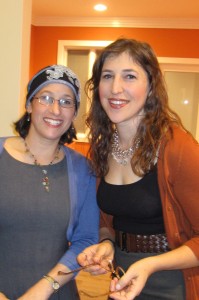
Yes, she did say that, and this is the dress.
I tried not to gush, or to tell her all of this background which would have sounded ridiculous to her, but to instead maintain my customary non-groupie-like composure. Since I fell out somewhere between polite and out-right gushing, I think I came across as a complete weirdo. I also think she must be really used to it.
More than anything else, I really appreciated learning from her that evening. Much more than an actress she is a true thinker. A PhD in Neurology, she is intellectual and deliberate in her approach to just about everything, including her faith. One of the things she said that struck me the most is that she knew she was on a ladder of personal growth. But she needed to understand the shape and structure of the ladder, i.e. Jewish law, philosophy and theology, before being able to reach her hand off of it and safely out to Hashem. I have used the analogy of a ladder often in describing my own personal Jewish reality and I found her description so apt.
I left the evening sure that if we just had some time together Mayim and I would just be great friends. This woman who had the career that I tried not to covet as a teenager is now in the arduous process of melding her love of acting with her growing love of Judaism. I feel for her, relating so strongly to the many choices and changes that I made along the way. Okay, so I didn’t exactly have to contend with being on a PRIME TIME SITCOM, but I made my own sacrifices.
I think it is to Mayim Bialik’s credit that she left me with that impression that we would be buddies if only… as well as no doubt 90% of the other people in that room, and 90% of the women all over the country who watch her and have met her.
One other comment she made that stayed with me was her retelling of a fundamental question Allison asked her when they began learning together many years ago as chevrutot, or study partners: “Why do you think G-d gave you this amazing success and what do you think he wants you to do with it?” She didn’ t have any answers then, but it was a life-changing reference point that she said Allison has stuck with and revisits with her. She is taking a lot of composed, rational middle-aged women like myself and turning us into groupies, and getting an increasing amount of attention about her Jewish growth and her holistic parenting choices.
So she is doing much with her notoriety, and I think she is at least part of the way towards figuring out an answer.